







大公社評英譯/可考慮一視同仁收購宏志閣 Should equally incorporate Wang Chi House into the acquisition
 2026.03.09 04:21


 字號
字號


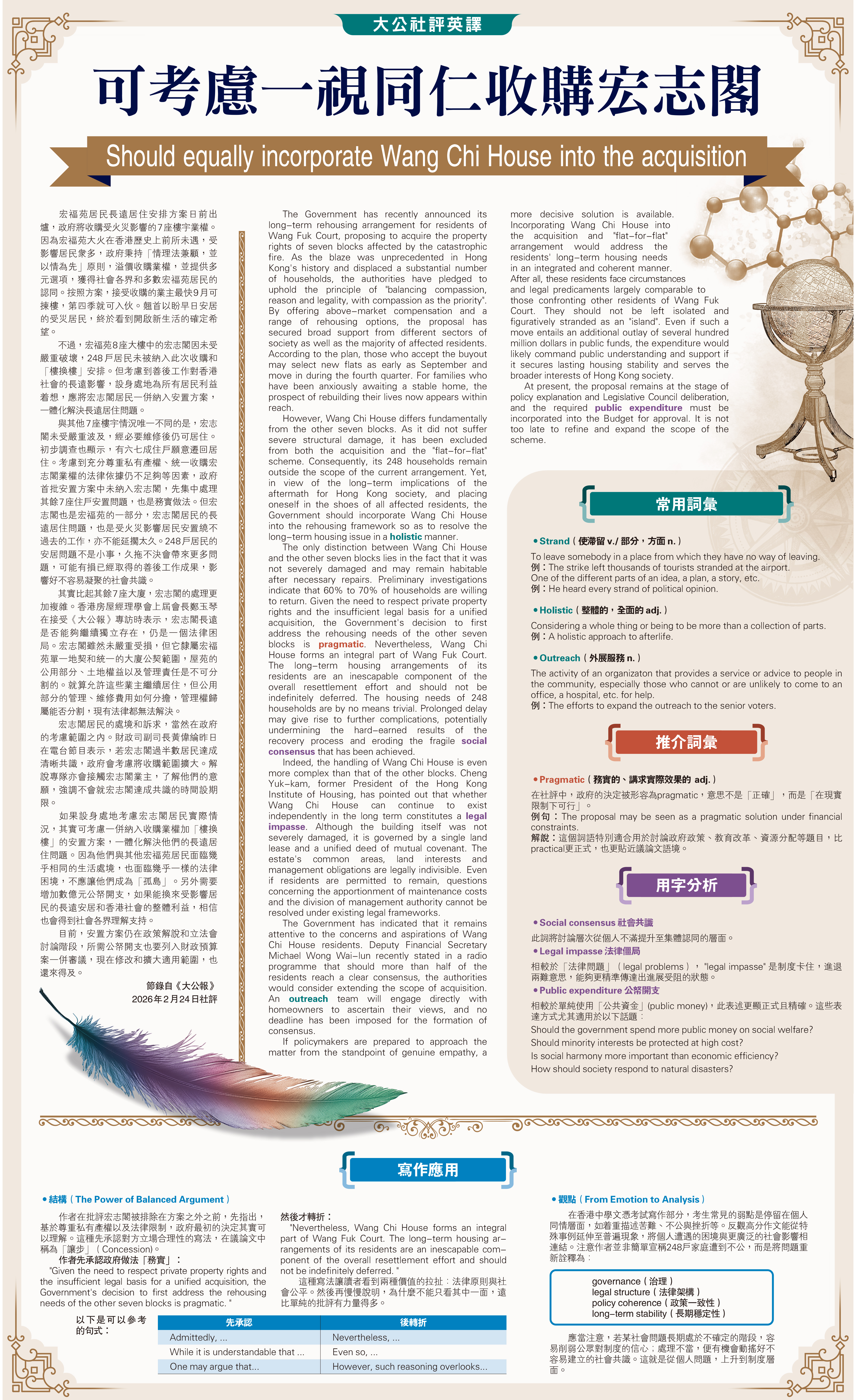
宏福苑居民長遠居住安排方案日前出爐,政府將收購受火災影響的7座樓宇業權。因為宏福苑大火在香港歷史上前所未遇,受影響居民衆多,政府秉持「情理法兼顧,並以情為先」原則,溢價收購業權,並提供多元選項,獲得社會各界和多數宏福苑居民的認同。按照方案,接受收購的業主最快9月可揀樓,第四季就可入伙。翹首以盼早日安居的受災居民,終於看到開啟新生活的確定希望。
不過,宏福苑8座大樓中的宏志閣因未受嚴重破壞,248戶居民未被納入此次收購和「樓換樓」安排。但考慮到善後工作對香港社會的長遠影響,設身處地為所有居民利益着想,應將宏志閣居民一併納入安置方案,一體化解決長遠居住問題。
與其他7座樓宇情況唯一不同的是,宏志閣未受嚴重波及,經必要維修後仍可居住。初步調查也顯示,有六七成住戶願意遷回居住。考慮到充分尊重私有產權、統一收購宏志閣業權的法律依據仍不足夠等因素,政府首批安置方案中未納入宏志閣,先集中處理其餘7座住戶安置問題,也是務實做法。但宏志閣也是宏福苑的一部分,宏志閣居民的長遠居住問題,也是受火災影響居民安置繞不過去的工作,亦不能延擱太久。248戶居民的安居問題不是小事,久拖不決會帶來更多問題,可能有損已經取得的善後工作成果,影響好不容易凝聚的社會共識。
其實比起其餘7座大廈,宏志閣的處理更加複雜。香港房屋經理學會上屆會長鄭玉琴在接受《大公報》專訪時表示,宏志閣長遠是否能夠繼續獨立存在,仍是一個法律困局。宏志閣雖然未嚴重受損,但它隸屬宏福苑單一地契和統一的大廈公契範圍,屋苑的公用部分、土地權益以及管理責任是不可分割的。就算允許這些業主繼續居住,但公用部分的管理、維修費用如何分擔,管理權歸屬能否分割,現有法律都無法解決。
宏志閣居民的處境和訴求,當然在政府的考慮範圍之內。財政司副司長黃偉綸昨日在電台節目表示,若宏志閣過半數居民達成清晰共識,政府會考慮將收購範圍擴大。解說專隊亦會接觸宏志閣業主,了解他們的意願,強調不會就宏志閣達成共識的時間設期限。
如果設身處地考慮宏志閣居民實際情況,其實可考慮一併納入收購業權加「樓換樓」的安置方案,一體化解決他們的長遠居住問題。因為他們與其他宏福苑居民面臨幾乎相同的生活處境,也面臨幾乎一樣的法律困境,不應讓他們成為「孤島」。另外需要增加數億元公帑開支,如果能換來受影響居民的長遠安居和香港社會的整體利益,相信也會得到社會各界理解支持。
目前,安置方案仍在政策解說和立法會討論階段,所需公帑開支也要列入財政預算案一併審議,現在修改和擴大適用範圍,也還來得及。
節錄自《大公報》
2026年2月24日社評
The Government has recently announced its long-term rehousing arrangement for residents of Wang Fuk Court, proposing to acquire the property rights of seven blocks affected by the catastrophic fire. As the blaze was unprecedented in Hong Kong's history and displaced a substantial number of households, the authorities have pledged to uphold the principle of "balancing compassion, reason and legality, with compassion as the priority". By offering above-market compensation and a range of rehousing options, the proposal has secured broad support from different sectors of society as well as the majority of affected residents. According to the plan, those who accept the buyout may select new flats as early as September and move in during the fourth quarter. For families who have been anxiously awaiting a stable home, the prospect of rebuilding their lives now appears within reach.
However, Wang Chi House differs fundamentally from the other seven blocks. As it did not suffer severe structural damage, it has been excluded from both the acquisition and the "flat-for-flat" scheme. Consequently, its 248 households remain outside the scope of the current arrangement. Yet, in view of the long-term implications of the aftermath for Hong Kong society, and placing oneself in the shoes of all affected residents, the Government should incorporate Wang Chi House into the rehousing framework so as to resolve the long-term housing issue in a holistic manner.
The only distinction between Wang Chi House and the other seven blocks lies in the fact that it was not severely damaged and may remain habitable after necessary repairs. Preliminary investigations indicate that 60% to 70% of households are willing to return. Given the need to respect private property rights and the insufficient legal basis for a unified acquisition, the Government's decision to first address the rehousing needs of the other seven blocks is pragmatic. Nevertheless, Wang Chi House forms an integral part of Wang Fuk Court. The long-term housing arrangements of its residents are an inescapable component of the overall resettlement effort and should not be indefinitely deferred. The housing needs of 248 households are by no means trivial. Prolonged delay may give rise to further complications, potentially undermining the hard-earned results of the recovery process and eroding the fragile social consensus that has been achieved.
Indeed, the handling of Wang Chi House is even more complex than that of the other blocks. Cheng Yuk-kam, former President of the Hong Kong Institute of Housing, has pointed out that whether Wang Chi House can continue to exist independently in the long term constitutes a legal impasse. Although the building itself was not severely damaged, it is governed by a single land lease and a unified deed of mutual covenant. The estate's common areas, land interests and management obligations are legally indivisible. Even if residents are permitted to remain, questions concerning the apportionment of maintenance costs and the division of management authority cannot be resolved under existing legal frameworks.
The Government has indicated that it remains attentive to the concerns and aspirations of Wang Chi House residents. Deputy Financial Secretary Michael Wong Wai-lun recently stated in a radio programme that should more than half of the residents reach a clear consensus, the authorities would consider extending the scope of acquisition. An outreach team will engage directly with homeowners to ascertain their views, and no deadline has been imposed for the formation of consensus.
If policymakers are prepared to approach the matter from the standpoint of genuine empathy, a more decisive solution is available. Incorporating Wang Chi House into the acquisition and "flat-for-flat" arrangement would address the residents' long-term housing needs in an integrated and coherent manner. After all, these residents face circumstances and legal predicaments largely comparable to those confronting other residents of Wang Fuk Court. They should not be left isolated and figuratively stranded as an "island". Even if such a move entails an additional outlay of several hundred million dollars in public funds, the expenditure would likely command public understanding and support if it secures lasting housing stability and serves the broader interests of Hong Kong society.
At present, the proposal remains at the stage of policy explanation and Legislative Council deliberation, and the required public expenditure must be incorporated into the Budget for approval. It is not too late to refine and expand the scope of the scheme.
常用詞彙
•Strand(使滯留 v./ 部分,方面 n.)
To leave somebody in a place from which they have no way of leaving.
例:The strike left thousands of tourists stranded at the airport.
One of the different parts of an idea, a plan, a story, etc.
例:He heard every strand of political opinion.
•Holistic(整體的,全面的 adj.)
Considering a whole thing or being to be more than a collection of parts.
例:A holistic approach to afterlife.
•Outreach(外展服務 n.)
The activity of an organizaton that provides a service or advice to people in the community, especially those who cannot or are unlikely to come to an office, a hospital, etc. for help.
例:The efforts to expand the outreach to the senior voters.
推介詞彙
•Pragmatic(務實的、講求實際效果的 adj.)
在社評中,政府的決定被形容為pragmatic,意思不是「正確」,而是「在現實限制下可行」。
例句:The proposal may be seen as a pragmatic solution under financial constraints.
解說:這個詞語特別適合用於討論政府政策、教育改革、資源分配等題目,比 practical更正式,也更貼近議論文語境。
用字分析
•Social consensus 社會共識
此詞將討論層次從個人不滿提升至集體認同的層面。
•Legal impasse 法律僵局
相較於「法律問題」(legal problems), "legal impasse" 是制度卡住,進退兩難意思,能夠更精準傳達出進展受阻的狀態。
•Public expenditure 公帑開支
相較於單純使用「公共資金」(public money),此表述更顯正式且精確。這些表達方式尤其適用於以下話題:
Should the government spend more public money on social welfare?
Should minority interests be protected at high cost?
Is social harmony more important than economic efficiency?
How should society respond to natural disasters?
寫作應用
•結構(The Power of Balanced Argument)
作者在批評宏志閣被排除在方案之外之前,先指出,基於尊重私有產權以及法律限制,政府最初的決定其實可以理解。這種先承認對方立場合理性的寫法,在議論文中稱為「讓步」(Concession)。
作者先承認政府做法「務實」:
"Given the need to respect private property rights and the insufficient legal basis for a unified acquisition, the Government's decision to first address the rehousing needs of the other seven blocks is pragmatic. "
然後才轉折:
"Nevertheless, Wang Chi House forms an integral part of Wang Fuk Court. The long-term housing arrangements of its residents are an inescapable component of the overall resettlement effort and should not be indefinitely deferred. "
這種寫法讓讀者看到兩種價值的拉扯:法律原則與社會公平。然後再慢慢說明,為什麼不能只看其中一面,遠比單純的批評有力量得多。
•觀點(From Emotion to Analysis)
在香港中學文憑考試寫作部分,考生常見的弱點是停留在個人同情層面,如着重描述苦難、不公與挫折等。反觀高分作文能從特殊事例延伸至普遍現象,將個人遭遇的困境與更廣泛的社會影響相連結。注意作者並非簡單宣稱248戶家庭遭到不公,而是將問題重新詮釋為:
governance(治理)
legal structure(法律架構)
policy coherence(政策一致性)
long-term stability(長期穩定性)
應當注意,若某社會問題長期處於不確定的階段,容易削弱公眾對制度的信心;處理不當,便有機會動搖好不容易建立的社會共識。這就是從個人問題,上升到制度層面。