











大公社評英譯/推動制度創新 重奪土地主導權 Promoting institutional innovation to retake control of land development
2026.03.23 04:22:07
 字號:
字號:
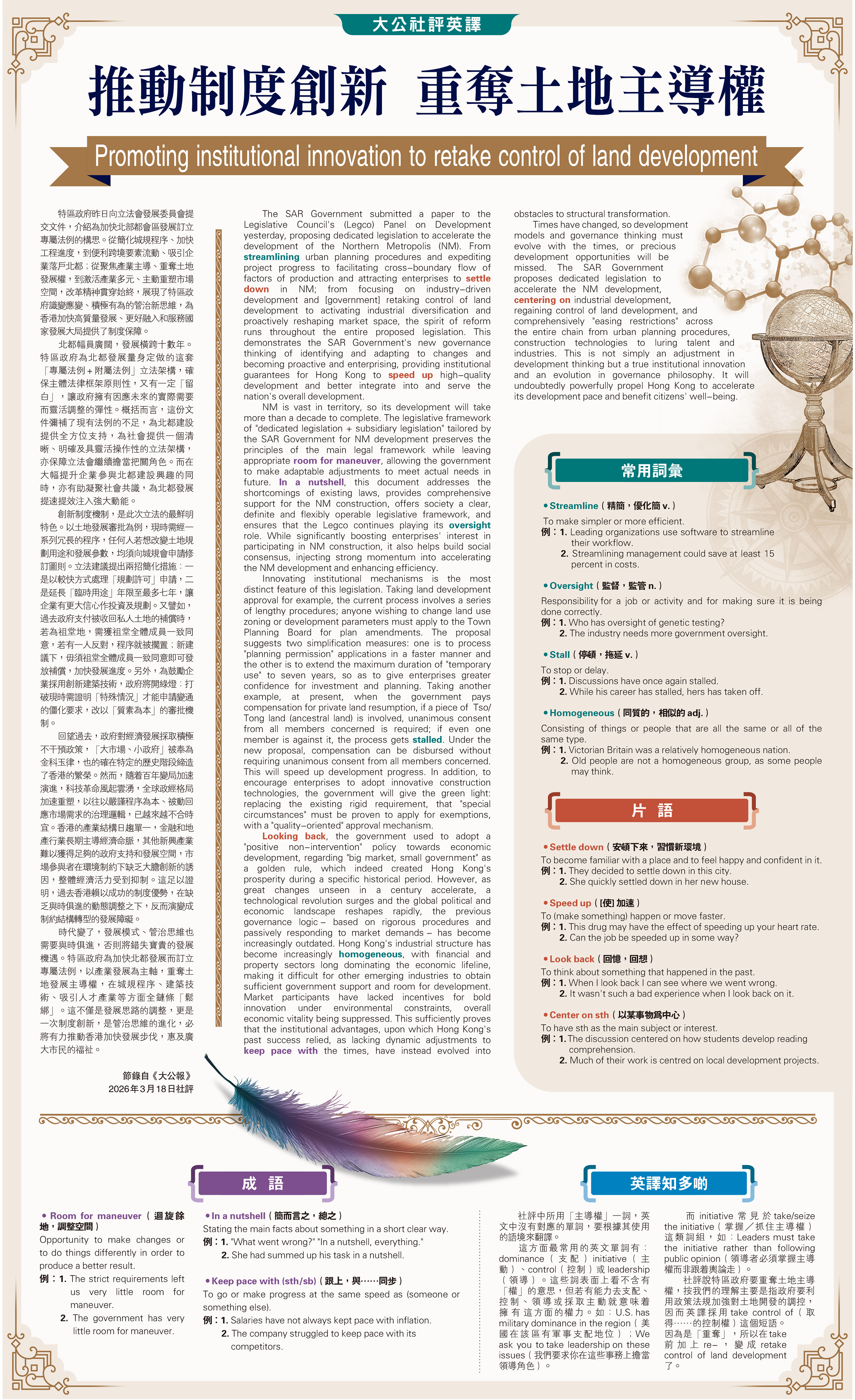
特區政府昨日向立法會發展委員會提交文件,介紹為加快北部都會區發展訂立專屬法例的構思。從簡化城規程序、加快工程進度,到便利跨境要素流動、吸引企業落戶北都;從聚焦產業主導、重奪土地發展權,到激活產業多元、主動重塑市場空間,改革精神貫穿始終,展現了特區政府識變應變、積極有為的管治新思維,為香港加快高質量發展、更好融入和服務國家發展大局提供了制度保障。
北都幅員廣闊,發展橫跨十數年。特區政府為北都發展量身定做的這套「專屬法例+附屬法例」立法架構,確保主體法律框架原則性,又有一定「留白」,讓政府擁有因應未來的實際需要而靈活調整的彈性。概括而言,這份文件彌補了現有法例的不足,為北都建設提供全方位支持,為社會提供一個清晰、明確及具靈活操作性的立法架構,亦保障立法會繼續擔當把關角色。而在大幅提升企業參與北都建設興趣的同時,亦有助凝聚社會共識,為北都發展提速提效注入強大動能。
創新制度機制,是此次立法的最鮮明特色。以土地發展審批為例,現時需經一系列冗長的程序,任何人若想改變土地規劃用途和發展參數,均須向城規會申請修訂圖則。立法建議提出兩招簡化措施:一是以較快方式處理「規劃許可」申請,二是延長「臨時用途」年限至最多七年,讓企業有更大信心作投資及規劃。又譬如,過去政府支付被收回私人土地的補償時,若為祖堂地,需獲祖堂全體成員一致同意,若有一人反對,程序就被擱置;新建議下,毋須祖堂全體成員一致同意即可發放補償,加快發展進度。另外,為鼓勵企業採用創新建築技術,政府將開綠燈:打破現時需證明「特殊情況」才能申請變通的僵化要求,改以「質素為本」的審批機制。
回望過去,政府對經濟發展採取積極不干預政策,「大市場、小政府」被奉為金科玉律,也的確在特定的歷史階段締造了香港的繁榮。然而,隨着百年變局加速演進,科技革命風起雲湧,全球政經格局加速重塑,以往以嚴謹程序為本、被動回應市場需求的治理邏輯,已越來越不合時宜。香港的產業結構日趨單一,金融和地產行業長期主導經濟命脈,其他新興產業難以獲得足夠的政府支持和發展空間,市場參與者在環境制約下缺乏大膽創新的誘因,整體經濟活力受到抑制。這足以證明,過去香港賴以成功的制度優勢,在缺乏與時俱進的動態調整之下,反而演變成制約結構轉型的發展障礙。
時代變了,發展模式、管治思維也需要與時俱進,否則將錯失寶貴的發展機遇。特區政府為加快北都發展而訂立專屬法例,以產業發展為主軸,重奪土地發展主導權,在城規程序、建築技術、吸引人才產業等方面全鏈條「鬆綁」。這不僅是發展思路的調整,更是一次制度創新,是管治思維的進化,必將有力推動香港加快發展步伐,惠及廣大市民的福祉。
節錄自《大公報》
2026年3月18日社評
The SAR Government submitted a paper to the Legislative Council's (Legco) Panel on Development yesterday, proposing dedicated legislation to accelerate the development of the Northern Metropolis (NM). From streamlining urban planning procedures and expediting project progress to facilitating cross-boundary flow of factors of production and attracting enterprises to settle down in NM; from focusing on industry-driven development and [government] retaking control of land development to activating industrial diversification and proactively reshaping market space, the spirit of reform runs throughout the entire proposed legislation. This demonstrates the SAR Government's new governance thinking of identifying and adapting to changes and becoming proactive and enterprising, providing institutional guarantees for Hong Kong to speed up high-quality development and better integrate into and serve the nation's overall development.
NM is vast in territory, so its development will take more than a decade to complete. The legislative framework of "dedicated legislation + subsidiary legislation" tailored by the SAR Government for NM development preserves the principles of the main legal framework while leaving appropriate room for maneuver, allowing the government to make adaptable adjustments to meet actual needs in future. In a nutshell, this document addresses the shortcomings of existing laws, provides comprehensive support for the NM construction, offers society a clear, definite and flexibly operable legislative framework, and ensures that the Legco continues playing its oversight role. While significantly boosting enterprises' interest in participating in NM construction, it also helps build social consensus, injecting strong momentum into accelerating the NM development and enhancing efficiency.
Innovating institutional mechanisms is the most distinct feature of this legislation. Taking land development approval for example, the current process involves a series of lengthy procedures; anyone wishing to change land use zoning or development parameters must apply to the Town Planning Board for plan amendments. The proposal suggests two simplification measures: one is to process "planning permission" applications in a faster manner and the other is to extend the maximum duration of "temporary use" to seven years, so as to give enterprises greater confidence for investment and planning. Taking another example, at present, when the government pays compensation for private land resumption, if a piece of Tso/Tong land (ancestral land) is involved, unanimous consent from all members concerned is required; if even one member is against it, the process gets stalled. Under the new proposal, compensation can be disbursed without requiring unanimous consent from all members concerned. This will speed up develo pment progress. In addition, to encourage enterprises to adopt innovative construction technologies, the government will give the green light: replacing the existing rigid requirement, that "special circumstances" must be proven to apply for exemptions, with a "quality-oriented" approval mechanism.
Looking back, the government used to adopt a "positive non-intervention" policy towards economic development, regarding "big market, small government" as a golden rule, which indeed created Hong Kong's prosperity during a specific historical period. However, as great changes unseen in a century accelerate, a technological revolution surges and the global political and economic landscape reshapes rapidly, the previous governance logic - based on rigorous procedures and passively responding to market demands - has become increasingly outdated. Hong Kong's industrial structure has become increasingly homogeneous, with financial and property sectors long dominating the economic lifeline, making it difficult for other emerging industries to obtain sufficient government support and room for development. Market participants have lacked incentives for bold innovation under environmental constraints, overall economic vitality being suppressed. This sufficiently proves that the institutional advantages, upon which Hong Kong's past success relied, as lacking dynamic adjustments to keep pace with the times, have instead evolved into obstacles to structural transformation.
Times have changed, so development models and governance thinking must evolve with the times, or precious development opportunities will be missed. The SAR Government proposes dedicated legislation to accelerate the NM development, centering on industrial development, regaining control of land development, and comprehensively "easing restrictions" across the entire chain from urban planning procedures, construction technologies to luring talent and industries. This is not simply an adjustment in development thinking but a true institutional innovation and an evolution in governance philosophy. It will undoubtedly powerfully propel Hong Kong to accelerate its development pace and benefit citizens' well-being.
常用詞彙
•Streamline(精簡,優化簡 v.)
To make simpler or more efficient.
例:1. Leading organizations use software to streamline their workflow.
2. Streamlining management could save at least 15 percent in costs.
•Oversight(監督,監管 n.)
Responsibility for a job or activity and for making sure it is being done correctly.
例:1. Who has oversight of genetic testing?
2. The industry needs more government oversight.
•Stall(停頓,拖延 v.)
To stop or delay.
例:1. Discussions have once again stalled.
2. While his career has stalled, hers has taken off.
•Homogeneous(同質的,相似的 adj.)
Consisting of things or people that are all the same or all of the same type.
例:1. Victorian Britain was a relatively homogeneous nation.
2. Old people are not a homogeneous group, as some people may think.
片 語
•Settle down(安頓下來,習慣新環境)
To become familiar with a place and to feel happy and confident in it.
例:1. They decided to settle down in this city.
2. She quickly settled down in her new house.
•Speed up([使] 加速)
To (make something) happen or move faster.
例:1. This drug may have the effect of speeding up your heart rate.
2. Can the job be speeded up in some way?
•Look back(回憶,回想)
To think about something that happened in the past.
例:1. When I look back I can see where we went wrong.
2. It wasn't such a bad experience when I look back on it.
•Center on sth(以某事物為中心)
To have sth as the main subject or interest.
例:1. The discussion centered on how students develop reading comprehension.
2. Much of their work is centred on local development projects.
成 語
•Room for maneuver(迴旋餘地,調整空間)
Opportunity to make changes or to do things differently in order to produce a better result.
例:1. The strict requirements left us very little room for maneuver.
2. The government has very little room for maneuver.
•In a nutshell(簡而言之,總之)
Stating the main facts about something in a short clear way.
例:1. "What went wrong?" "In a nutshell, everything."
2. She had summed up his task in a nutshell.
•Keep pace with (sth/sb)(跟上,與……同步)
To go or make progress at the same speed as (someone or something else).
例:1. Salaries have not always kept pace with inflation.
2. The company struggled to keep pace with its competitors.
英譯知多啲
社評中所用「主導權」一詞,英文中沒有對應的單詞,要根據其使用的語境來翻譯。
這方面最常用的英文單詞有:dominance(支配)initiative(主動)、control(控制)或 leadership(領導)。這些詞表面上看不含有「權」的意思,但若有能力去支配、控制、領導或採取主動就意味着擁有這方面的權力。如:U.S. has military dominance in the region(美國在該區有軍事支配地位);We ask you to take leadership on these issues(我們要求你在這些事務上擔當領導角色)。
而initiative常見於 take/seize the initiative(掌握/抓住主導權)這類詞組,如:Leaders must take the initiative rather than following public opinion(領導者必須掌握主導權而非跟着輿論走)。
社評說特區政府要重奪土地主導權,按我們的理解主要是指政府要利用政策法規加強對土地開發的調控,因而英譯採用take control of(取得……的控制權)這個短語。因為是「重奪」,所以在take前加上re-,變成retake control of land development了。


評論