










大公社評英譯/公聽會初揭大火真相 制度改革全速推進
2026.03.30 04:22:34
 字號:
字號:
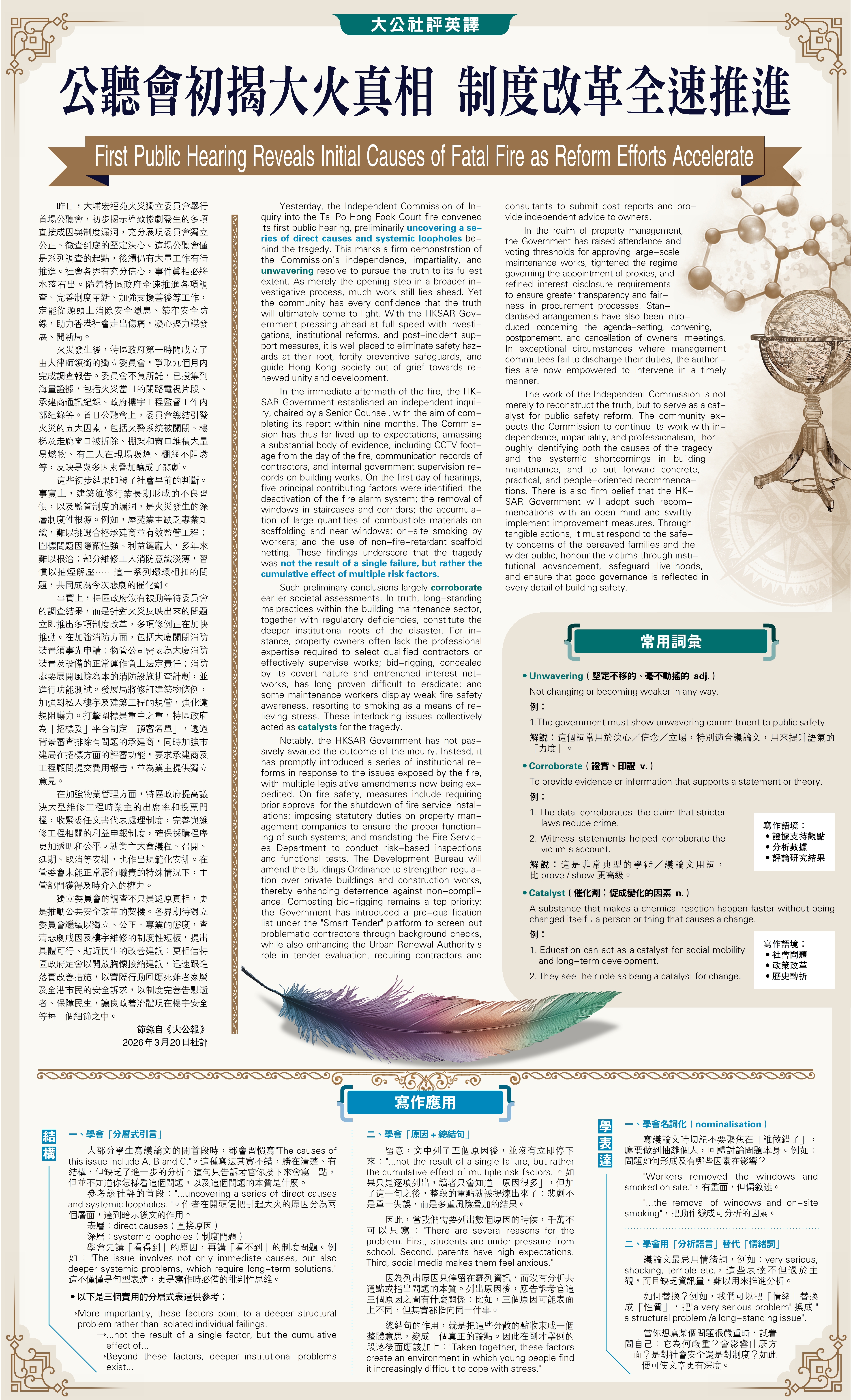
昨日,大埔宏福苑火災獨立委員會舉行首場公聽會,初步揭示導致慘劇發生的多項直接成因與制度漏洞,充分展現委員會獨立公正、徹查到底的堅定決心。這場公聽會僅是系列調查的起點,後續仍有大量工作有待推進。社會各界有充分信心,事件眞相必將水落石出。隨着特區政府全速推進各項調查、完善制度革新、加強支援善後等工作,定能從源頭上消除安全隱患、築牢安全防線,助力香港社會走出傷痛,凝心聚力謀發展、開新局。
火災發生後,特區政府第一時間成立了由大律師領銜的獨立委員會,爭取九個月內完成調查報告。委員會不負所託,已搜集到海量證據,包括火災當日的閉路電視片段、承建商通訊紀錄、政府樓宇工程監督工作內部紀錄等。首日公聽會上,委員會總結引發火災的五大因素,包括火警系統被關閉、樓梯及走廊窗口被拆除、棚架和窗口堆積大量易燃物、有工人在現場吸煙、棚網不阻燃等,反映是衆多因素疊加釀成了悲劇。
這些初步結果印證了社會早前的判斷。事實上,建築維修行業長期形成的不良習慣,以及監管制度的漏洞,是火災發生的深層制度性根源。例如,屋苑業主缺乏專業知識,難以挑選合格承建商並有效監管工程;圍標問題因隱蔽性強、利益鏈龐大,多年來難以根治;部分維修工人消防意識淡薄,習慣以抽煙解壓……這一系列環環相扣的問題,共同成為今次悲劇的催化劑。
事實上,特區政府沒有被動等待委員會的調查結果,而是針對火災反映出來的問題立即推出多項制度改革,多項修例正在加快推動。在加強消防方面,包括大廈關閉消防裝置須事先申請;物管公司需要為大廈消防裝置及設備的正常運作負上法定責任;消防處要展開風險為本的消防設施排查計劃,並進行功能測試。發展局將修訂建築物條例,加強對私人樓宇及建築工程的規管,強化違規阻嚇力。打擊圍標是重中之重,特區政府為「招標妥」平台制定「預審名單」,透過背景審查排除有問題的承建商,同時加強市建局在招標方面的評審功能,要求承建商及工程顧問提交費用報告,並為業主提供獨立意見。
在加強物業管理方面,特區政府提高議決大型維修工程時業主的出席率和投票門檻,收緊委任文書代表處理制度,完善與維修工程相關的利益申報制度,確保採購程序更加透明和公平。就業主大會議程、召開、延期、取消等安排,也作出規範化安排。在管委會未能正常履行職責的特殊情況下,主管部門獲得及時介入的權力。
獨立委員會的調查不只是還原真相,更是推動公共安全改革的契機。各界期待獨立委員會繼續以獨立、公正、專業的態度,查清悲劇成因及樓宇維修的制度性短板,提出具體可行、貼近民生的改善建議;更相信特區政府定會以開放胸懷接納建議,迅速跟進落實改善措施,以實際行動回應死難者家屬及全港市民的安全訴求,以制度完善告慰逝者、保障民生,讓良政善治體現在樓宇安全等每一個細節之中。
節錄自《大公報》
2026年3月20日社評
First Public Hearing Reveals Initial Causes of Fatal Fire as Reform Efforts Accelerate
Yesterday, the Independent Commission of Inquiry into the Tai Po Hong Fook Court fire convened its first public hearing, preliminarily uncovering a series of direct causes and systemic loopholes behind the tragedy. This marks a firm demonstration of the Commission's independence, impartiality, and unwavering resolve to pursue the truth to its fullest extent. As merely the opening step in a broader investigative process, much work still lies ahead. Yet the community has every confidence that the truth will ultimately come to light. With the HKSAR Government pressing ahead at full speed with investigations, institutional reforms, and post-incident support measures, it is well placed to eliminate safety hazards at their root, fortify preventive safeguards, and guide Hong Kong society out of grief towards renewed unity and development.
In the immediate aftermath of the fire, the HKSAR Government established an independent inquiry, chaired by a Senior Counsel, with the aim of completing its report within nine months. The Commission has thus far lived up to expectations, amassing a substantial body of evidence, including CCTV footage from the day of the fire, communication records of contractors, and internal government supervision records on building works. On the first day of hearings, five principal contributing factors were identified: the deactivation of the fire alarm system; the removal of windows in staircases and corridors; the accumulation of large quantities of combustible materials on scaffolding and near windows; on-site smoking by workers; and the use of non-fire-retardant scaffold netting. These findings underscore that the tragedy was not the result of a single failure, but rather the cumulative effect of multiple risk factors.
Such preliminary conclusions largely corroborate earlier societal assessments. In truth, long-standing malpractices within the building maintenance sector, together with regulatory deficiencies, constitute the deeper institutional roots of the disaster. For instance, property owners often lack the professional expertise required to select qualified contractors or effectively supervise works; bid-rigging, concealed by its covert nature and entrenched interest networks, has long proven difficult to eradicate; and some maintenance workers display weak fire safety awareness, resorting to smoking as a means of relieving stress. These interlocking issues collectively acted as catalysts for the tragedy.
Notably, the HKSAR Government has not passively awaited the outcome of the inquiry. Instead, it has promptly introduced a series of institutional reforms in response to the issues exposed by the fire, with multiple legislative amendments now being expedited. On fire safety, measures include requiring prior approval for the shutdown of fire service installations; imposing statutory duties on property management companies to ensure the proper functioning of such systems; and mandating the Fire Services Department to conduct risk-based inspections and functional tests. The Development Bureau will amend the Buildings Ordinance to strengthen regulation over private buildings and construction works, thereby enhancing deterrence against non-compliance. Combating bid-rigging remains a top priority: the Government has introduced a pre-qualification list under the "Smart Tender" platform to screen out problematic contractors through background checks, while also enhancing the Urban Renewal Authority's role in tender evaluation, requiring contractors and consultants to submit cost reports and provide independent advice to owners.
In the realm of property management, the Government has raised attendance and voting thresholds for approving large-scale maintenance works, tightened the regime governing the appointment of proxies, and refined interest disclosure requirements to ensure greater transparency and fairness in procurement processes. Standardised arrangements have also been introduced concerning the agenda-setting, convening, postponement, and cancellation of owners' meetings. In exceptional circumstances where management committees fail to discharge their duties, the authorities are now empowered to intervene in a timely manner.
The work of the Independent Commission is not merely to reconstruct the truth, but to serve as a catalyst for public safety reform. The community expects the Commission to continue its work with independence, impartiality, and professionalism, thoroughly identifying both the causes of the tragedy and the systemic shortcomings in building maintenance, and to put forward concrete, practical, and people-oriented recommendations. There is also firm belief that the HKSAR Government will adopt such recommendations with an open mind and swiftly implement improvement measures. Through tangible actions, it must respond to the safety concerns of the bereaved families and the wider public, honour the victims through institutional advancement, safeguard livelihoods, and ensure that good governance is reflected in every detail of building safety.
常用詞彙
•Unwavering(堅定不移的、毫不動搖的 adj.)
Not changing or becoming weaker in any way.
例:
1.The government must show unwavering commitment to public safety.
解說:這個詞常用於決心/信念/立場,特別適合議論文,用來提升語氣的「力度」。
•Corroborate(證實、印證 v.)
To provide evidence or information that supports a statement or theory.
例:
1. The data corroborates the claim that stricter laws reduce crime.
2. Witness statements helped corroborate the victim's account.
解說:這是非常典型的學術/議論文用詞,比 prove / show 更高級。
寫作語境:
•證據支持觀點
•分析數據
•評論研究結果
•Catalyst(催化劑;促成變化的因素 n.)
A substance that makes a chemical reaction happen faster without being changed itself ; a person or thing that causes a change.
例:
1. Education can act as a catalyst for social mobility and long-term development.
2. They see their role as being a catalyst for change.
寫作語境:
•社會問題
•政策改革
•歷史轉折
寫作應用
結構
一、學會「分層式引言」
大部分學生寫議論文的開首段時,都會習慣寫"The causes of this issue include A, B and C."。這種寫法其實不錯,勝在清楚、有結構,但缺乏了進一步的分析。這句只告訴考官你接下來會寫三點,但並不知道你怎樣看這個問題,以及這個問題的本質是什麼。
參考該社評的首段:"...uncovering a series of direct causes and systemic loopholes. "。作者在開頭便把引起大火的原因分為兩個層面,達到暗示後文的作用。
表層:direct causes(直接原因)
深層:systemic loopholes(制度問題)
學會先講「看得到」的原因,再講「看不到」的制度問題。例如:"The issue involves not only immediate causes, but also deeper systemic problems, which require long-term solutions."這不僅僅是句型表達,更是寫作時必備的批判性思維。
•以下是三個實用的分層式表達供參考:
→More importantly, these factors point to a deeper structural problem rather than isolated individual failings.
→...not the result of a single factor, but the cumulative effect of...
→Beyond these factors, deeper institutional problems exist...
二、學會「原因 + 總結句」
留意,文中列了五個原因後,並沒有立即停下來:"...not the result of a single failure, but rather the cumulative effect of multiple risk factors."。如果只是逐項列出,讀者只會知道「原因很多」,但加了這一句之後,整段的重點就被提煉出來了:悲劇不是單一失誤,而是多重風險疊加的結果。
因此,當我們需要列出數個原因的時候,千萬不可以只寫:"There are several reasons for the problem. First, students are under pressure from school. Second, parents have high expectations. Third, social media makes them feel anxious."
因為列出原因只停留在羅列資訊,而沒有分析共通點或指出問題的本質。列出原因後,應告訴考官這三個原因之間有什麼關係:比如,三個原因可能表面上不同,但其實都指向同一件事。
總結句的作用,就是把這些分散的點收束成一個整體意思,變成一個真正的論點。因此在剛才舉例的段落後面應該加上:"Taken together, these factors create an environment in which young people find it increasingly difficult to cope with stress."
學表達
一、學會名詞化(nominalisation)
寫議論文時切記不要聚焦在「誰做錯了」,應要做到抽離個人,回歸討論問題本身。例如:問題如何形成及有哪些因素在影響?
"Workers removed the windows and smoked on site.",有畫面,但偏敘述。
"...the removal of windows and on-site smoking",把動作變成可分析的因素。
二、學會用「分析語言」替代「情緒詞」
議論文最忌用情緒詞,例如:very serious, shocking, terrible etc.,這些表達不但過於主觀,而且缺乏資訊量,難以用來推進分析。
如何替換?例如,我們可以把「情緒」替換成「性質」,把"a very serious problem" 換成 " a structural problem /a long-standing issue".
當你想寫某個問題很嚴重時,試着問自己:它為何嚴重?會影響什麼方面?是對社會安全還是對制度?如此便可使文章更有深度。


評論