









大公社評英譯/以「穩」應對不確定 以「快」搶抓新機遇
2026.04.20 04:23:28
 字號:
字號:
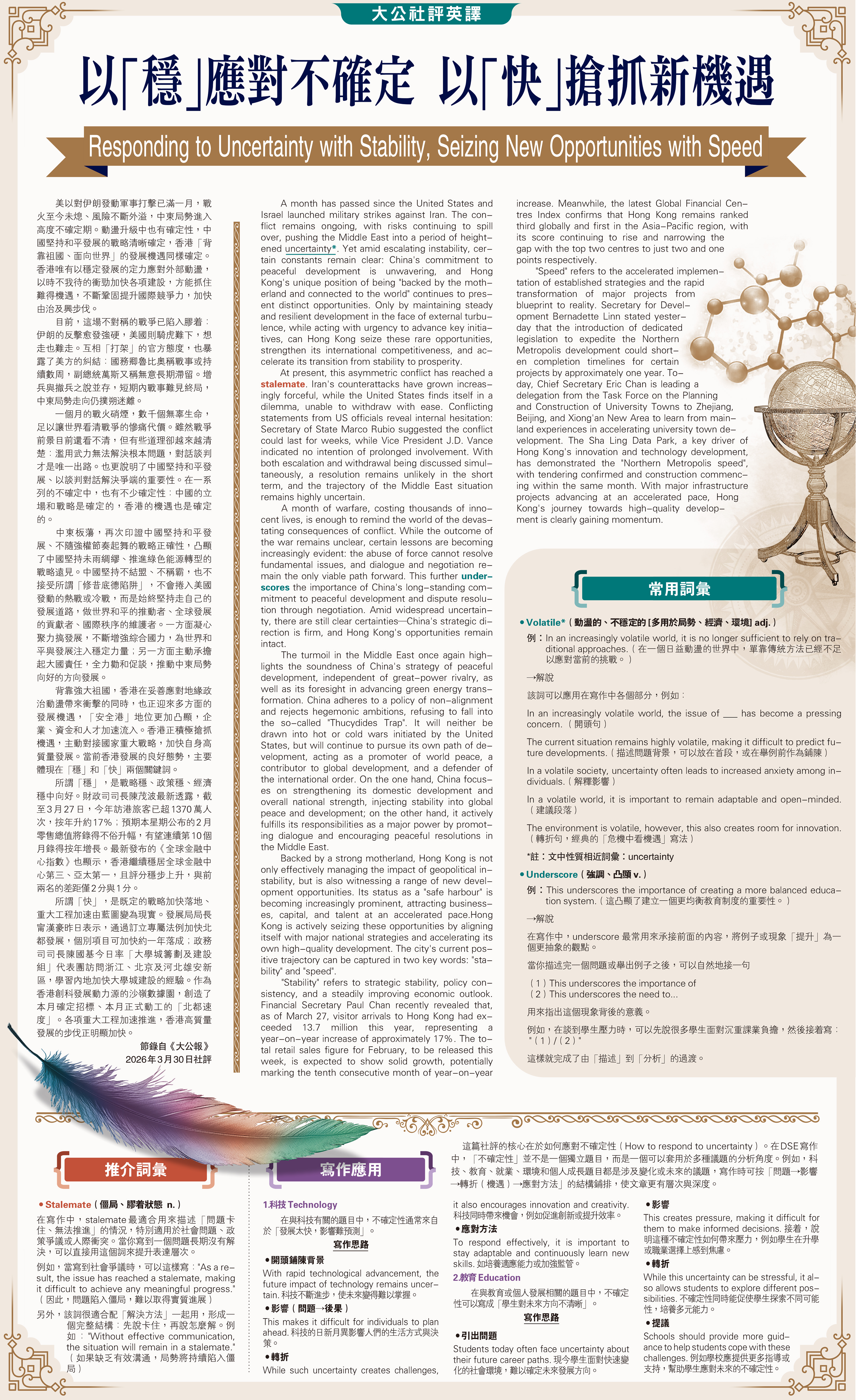
美以對伊朗發動軍事打擊已滿一月,戰火至今未熄、風險不斷外溢,中東局勢進入高度不確定期。動盪升級中也有確定性,中國堅持和平發展的戰略清晰確定,香港「背靠祖國、面向世界」的發展機遇同樣確定。香港唯有以穩定發展的定力應對外部動盪,以時不我待的衝勁加快各項建設,方能抓住難得機遇,不斷鞏固提升國際競爭力,加快由治及興步伐。
目前,這場不對稱的戰爭已陷入膠着:伊朗的反擊愈發強硬,美國則騎虎難下,想走也難走。互相「打架」的官方態度,也暴露了美方的糾結:國務卿魯比奧稱戰事或持續數周,副總統萬斯又稱無意長期滯留。增兵與撤兵之說並存,短期內戰事難見終局,中東局勢走向仍撲朔迷離。
一個月的戰火硝煙,數千個無辜生命,足以讓世界看清戰爭的慘痛代價。雖然戰爭前景目前還看不清,但有些道理卻越來越清楚:濫用武力無法解決根本問題,對話談判才是唯一出路。也更說明了中國堅持和平發展、以談判對話解決爭端的重要性。在一系列的不確定中,也有不少確定性:中國的立場和戰略是確定的,香港的機遇也是確定的。
中東板蕩,再次印證中國堅持和平發展、不隨強權節奏起舞的戰略正確性,凸顯了中國堅持未雨綢繆、推進綠色能源轉型的戰略遠見。中國堅持不結盟、不稱霸,也不接受所謂「修昔底德陷阱」,不會捲入美國發動的熱戰或冷戰,而是始終堅持走自己的發展道路,做世界和平的推動者、全球發展的貢獻者、國際秩序的維護者。一方面凝心聚力搞發展,不斷增強綜合國力,為世界和平與發展注入穩定力量;另一方面主動承擔起大國責任,全力勸和促談,推動中東局勢向好的方向發展。
背靠強大祖國,香港在妥善應對地緣政治動盪帶來衝擊的同時,也正迎來多方面的發展機遇,「安全港」地位更加凸顯,企業、資金和人才加速流入。香港正積極搶抓機遇,主動對接國家重大戰略,加快自身高質量發展。當前香港發展的良好態勢,主要體現在「穩」和「快」兩個關鍵詞。
所謂「穩」,是戰略穩、政策穩、經濟穩中向好。財政司司長陳茂波最新透露,截至3月27日,今年訪港旅客已超1370萬人次,按年升約17%;預期本星期公布的2月零售總值將錄得不俗升幅,有望連續第10個月錄得按年增長。最新發布的《全球金融中心指數》也顯示,香港繼續穩居全球金融中心第三、亞太第一,且評分穩步上升,與前兩名的差距僅2分與1分。
所謂「快」,是既定的戰略加快落地、重大工程加速由藍圖變為現實。發展局局長甯漢豪昨日表示,通過訂立專屬法例加快北都發展,個別項目可加快約一年落成;政務司司長陳國基今日率「大學城籌劃及建設組」代表團訪問浙江、北京及河北雄安新區,學習內地加快大學城建設的經驗。作為香港創科發展動力源的沙嶺數據園,創造了本月確定招標、本月正式動工的「北都速度」。各項重大工程加速推進,香港高質量發展的步伐正明顯加快。
節錄自《大公報》
2026年3月30日社評
Responding to Uncertainty with Stability, Seizing New Opportunities with Speed
A month has passed since the United States and Israel launched military strikes against Iran. The conflict remains ongoing, with risks continuing to spill over, pushing the Middle East into a period of heightened uncertainty*. Yet amid escalating instability, certain constants remain clear: China's commitment to peaceful development is unwavering, and Hong Kong's unique position of being "backed by the motherland and connected to the world" continues to present distinct opportunities. Only by maintaining steady and resilient development in the face of external turbulence, while acting with urgency to advance key initiatives, can Hong Kong seize these rare opportunities, strengthen its international competitiveness, and accelerate its transition from stability to prosperity.
At present, this asymmetric conflict has reached a stalemate. Iran's counterattacks have grown increasingly forceful, while the United States finds itself in a dilemma, unable to withdraw with ease. Conflicting statements from US officials reveal internal hesitation: Secretary of State Marco Rubio suggested the conflict could last for weeks, while Vice President J.D. Vance indicated no intention of prolonged involvement. With both escalation and withdrawal being discussed simultaneously, a resolution remains unlikely in the short term, and the trajectory of the Middle East situation remains highly uncertain.
A month of warfare, costing thousands of innocent lives, is enough to remind the world of the devastating consequences of conflict. While the outcome of the war remains unclear, certain lessons are becoming increasingly evident: the abuse of force cannot resolve fundamental issues, and dialogue and negotiation remain the only viable path forward. This further underscores the importance of China's long-standing commitment to peaceful development and dispute resolution through negotiation. Amid widespread uncertainty, there are still clear certainties—China's strategic direction is firm, and Hong Kong's opportunities remain intact.
The turmoil in the Middle East once again highlights the soundness of China's strategy of peaceful development, independent of great-power rivalry, as well as its foresight in advancing green energy transformation. China adheres to a policy of non-alignment and rejects hegemonic ambitions, refusing to fall into the so-called "Thucydides Trap". It will neither be drawn into hot or cold wars initiated by the United States, but will continue to pursue its own path of development, acting as a promoter of world peace, a contributor to global development, and a defender of the international order. On the one hand, China focuses on strengthening its domestic development and overall national strength, injecting stability into global peace and development; on the other hand, it actively fulfills its responsibilities as a major power by promoting dialogue and encouraging peaceful resolutions in the Middle East.
Backed by a strong motherland, Hong Kong is not only effectively managing the impact of geopolitical instability, but is also witnessing a range of new development opportunities. Its status as a "safe harbour" is becoming increasingly prominent, attracting businesses, capital, and talent at an accelerated pace.Hong Kong is actively seizing these opportunities by aligning itself with major national strategies and accelerating its own high-quality development. The city's current positive trajectory can be captured in two key words: "stability" and "speed".
"Stability" refers to strategic stability, policy consistency, and a steadily improving economic outlook. Financial Secretary Paul Chan recently revealed that, as of March 27, visitor arrivals to Hong Kong had exceeded 13.7 million this year, representing a year-on-year increase of approximately 17%. The total retail sales figure for February, to be released this week, is expected to show solid growth, potentially marking the tenth consecutive month of year-on-year increase. Meanwhile, the latest Global Financial Centres Index confirms that Hong Kong remains ranked third globally and first in the Asia-Pacific region, with its score continuing to rise and narrowing the gap with the top two centres to just two and one points respectively.
"Speed" refers to the accelerated implementation of established strategies and the rapid transformation of major projects from blueprint to reality. Secretary for Development Bernadette Linn stated yesterday that the introduction of dedicated legislation to expedite the Northern Metropolis development could shorten completion timelines for certain projects by approximately one year. Today, Chief Secretary Eric Chan is leading a delegation from the Task Force on the Planning and Construction of University Towns to Zhejiang, Beijing, and Xiong'an New Area to learn from mainland experiences in accelerating university town development. The Sha Ling Data Park, a key driver of Hong Kong's innovation and technology development, has demonstrated the "Northern Metropolis speed", with tendering confirmed and construction commencing within the same month. With major infrastructure projects advancing at an accelerated pace, Hong Kong's journey towards high-quality development is clearly gaining momentum.
常用詞彙
•Volatile*(動盪的、不穩定的 [多用於局勢、經濟、環境] adj.)
例:In an increasingly volatile world, it is no longer sufficient to rely on traditional approaches.(在一個日益動盪的世界中,單靠傳統方法已經不足以應對當前的挑戰。)
→解說
該詞可以應用在寫作中各個部分,例如:
In an increasingly volatile world, the issue of ___ has become a pressing concern. (開頭句)
The current situation remains highly volatile, making it difficult to predict future developments.(描述問題背景,可以放在首段,或在舉例前作為鋪陳)
In a volatile society, uncertainty often leads to increased anxiety among individuals.(解釋影響)
In a volatile world, it is important to remain adaptable and open-minded.(建議段落)
The environment is volatile, however, this also creates room for innovation. (轉折句,經典的「危機中看機遇」寫法)
*註:文中性質相近詞彙:uncertainty
•Underscore(強調、凸顯 v.)
例:This underscores the importance of creating a more balanced education system.(這凸顯了建立一個更均衡教育制度的重要性。)
→解說
在寫作中,underscore 最常用來承接前面的內容,將例子或現象「提升」為一個更抽象的觀點。
當你描述完一個問題或舉出例子之後,可以自然地接一句
(1)This underscores the importance of
(2)This underscores the need to...
用來指出這個現象背後的意義。
例如,在談到學生壓力時,可以先說很多學生面對沉重課業負擔,然後接着寫: "(1)/(2)"
這樣就完成了由「描述」到「分析」的過渡。
推介詞彙
•Stalemate(僵局、膠着狀態n.)
在寫作中,stalemate最適合用來描述「問題卡住、無法推進」的情況,特別適用於社會問題、政策爭議或人際衝突。當你寫到一個問題長期沒有解決,可以直接用這個詞來提升表達層次。
例如,當寫到社會爭議時,可以這樣寫:"As a result, the issue has reached a stalemate, making it difficult to achieve any meaningful progress."(因此,問題陷入僵局,難以取得實質進展)
另外,該詞很適合配「解決方法」一起用,形成一個完整結構:先說卡住,再說怎麼解。例如:"Without effective communication, the situation will remain in a stalemate."(如果缺乏有效溝通,局勢將持續陷入僵局)
寫作應用
這篇社評的核心在於如何應對不確定性(How to respond to uncertainty)。在DSE寫作中,「不確定性」並不是一個獨立題目,而是一個可以套用於多種議題的分析角度。例如,科技、教育、就業、環境和個人成長題目都是涉及變化或未來的議題,寫作時可按「問題→影響→轉折(機遇)→應對方法」的結構鋪排,使文章更有層次與深度。
1.科技 Technology
在與科技有關的題目中,不確定性通常來自於「發展太快,影響難預測」。
寫作思路
•開頭鋪陳背景
With rapid technological advancement, the future impact of technology remains uncertain. 科技不斷進步,使未來變得難以掌握。
•影響(問題→後果)
This makes it difficult for individuals to plan ahead. 科技的日新月異影響人們的生活方式與決策。
•轉折
While such uncertainty creates challenges, it also encourages innovation and creativity. 科技同時帶來機會,例如促進創新或提升效率。
•應對方法
To respond effectively, it is important to stay adaptable and continuously learn new skills. 如培養適應能力或加強監管。
2.教育 Education
在與教育或個人發展相關的題目中,不確定性可以寫成「學生對未來方向不清晰」。
寫作思路
•引出問題
Students today often face uncertainty about their future career paths. 現今學生面對快速變化的社會環境,難以確定未來發展方向。
•影響
This creates pressure, making it difficult for them to make informed decisions. 接着,說明這種不確定性如何帶來壓力,例如學生在升學或職業選擇上感到焦慮。
•轉折
While this uncertainty can be stressful, it also allows students to explore different possibilities. 不確定性同時能促使學生探索不同可能性,培養多元能力。
•提議
Schools should provide more guidance to help students cope with these challenges. 例如學校應提供更多指導或支持,幫助學生應對未來的不確定性。

評論