











大公社評英譯/以民為本積極應變 有力應對外部波動
2026.04.27 04:24:41
 字號:
字號:
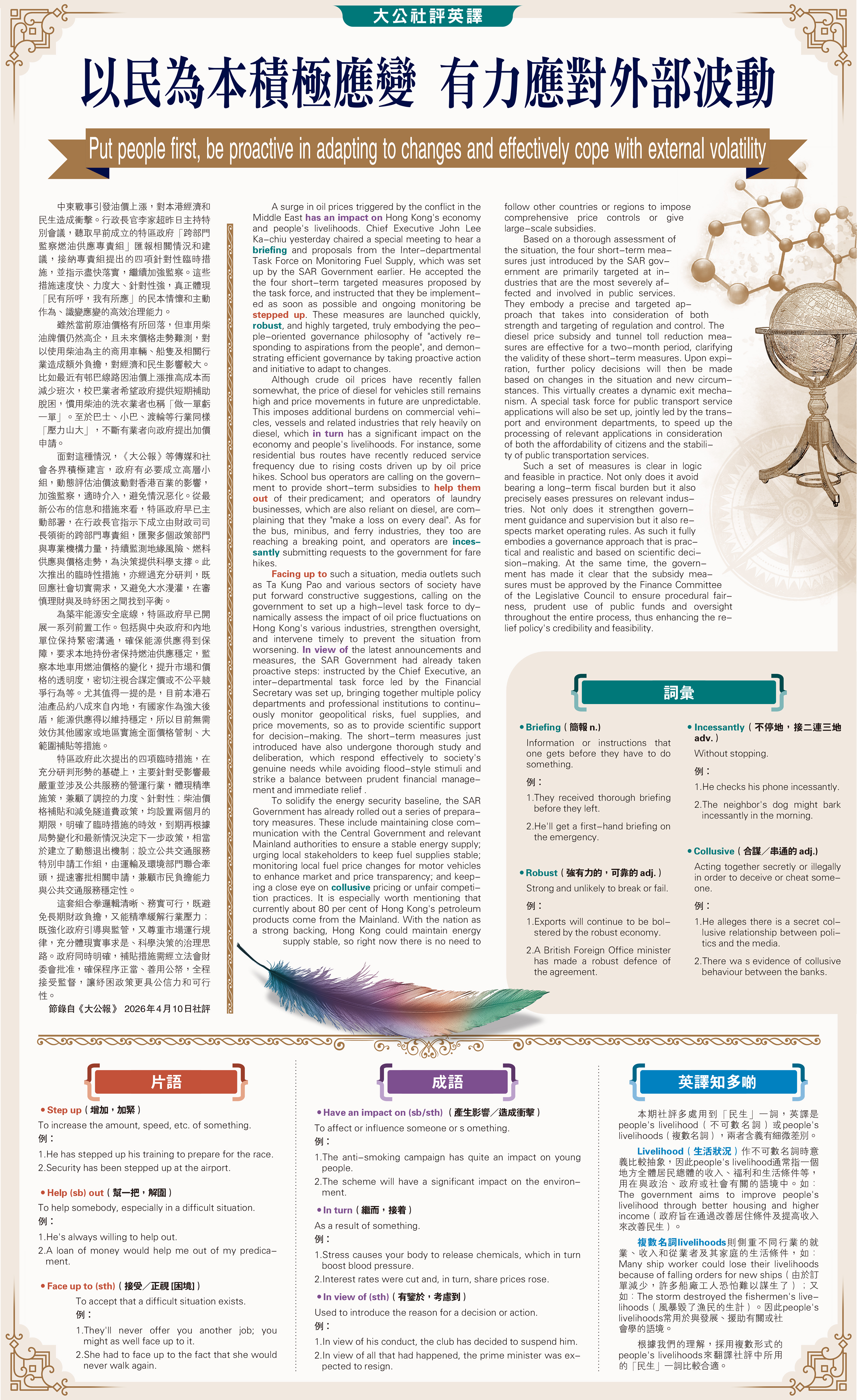
中東戰事引發油價上漲,對本港經濟和民生造成衝擊。行政長官李家超昨日主持特別會議,聽取早前成立的特區政府「跨部門監察燃油供應專責組」匯報相關情況和建議,接納專責組提出的四項針對性臨時措施,並指示盡快落實,繼續加強監察。這些措施速度快、力度大、針對性強,真正體現「民有所呼,我有所應」的民本情懷和主動作為、識變應變的高效治理能力。
雖然當前原油價格有所回落,但車用柴油牌價仍然高企,且未來價格走勢難測,對以使用柴油為主的商用車輛、船隻及相關行業造成額外負擔,對經濟和民生影響較大。比如最近有邨巴線路因油價上漲推高成本而減少班次,校巴業者希望政府提供短期補助脫困,慣用柴油的洗衣業者也稱「做一單虧一單」。至於巴士、小巴、渡輪等行業同樣「壓力山大」,不斷有業者向政府提出加價申請。
面對這種情況,《大公報》等傳媒和社會各界積極建言,政府有必要成立高層小組,動態評估油價波動對香港百業的影響,加強監察,適時介入,避免情況惡化。從最新公布的信息和措施來看,特區政府早已主動部署,在行政長官指示下成立由財政司司長領銜的跨部門專責組,匯聚多個政策部門與專業機構力量,持續監測地緣風險、燃料供應與價格走勢,為決策提供科學支撐。此次推出的臨時性措施,亦經過充分研判,既回應社會切實需求,又避免大水漫灌,在審慎理財與及時紓困之間找到平衡。
為築牢能源安全底線,特區政府早已開展一系列前置工作。包括與中央政府和內地單位保持緊密溝通,確保能源供應得到保障,要求本地持份者保持燃油供應穩定,監察本地車用燃油價格的變化,提升市場和價格的透明度,密切注視合謀定價或不公平競爭行為等。尤其值得一提的是,目前本港石油產品約八成來自內地,有國家作為強大後盾,能源供應得以維持穩定,所以目前無需效仿其他國家或地區實施全面價格管制、大範圍補貼等措施。
特區政府此次提出的四項臨時措施,在充分研判形勢的基礎上,主要針對受影響最嚴重並涉及公共服務的營運行業,體現精準施策,兼顧了調控的力度、針對性;柴油價格補貼和減免隧道費政策,均設置兩個月的期限,明確了臨時措施的時效,到期再根據局勢變化和最新情況決定下一步政策,相當於建立了動態退出機制;設立公共交通服務特別申請工作組,由運輸及環境部門聯合牽頭,提速審批相關申請,兼顧市民負擔能力與公共交通服務穩定性。
這套組合拳邏輯清晰、務實可行,既避免長期財政負擔,又能精準緩解行業壓力;既強化政府引導與監管,又尊重市場運行規律,充分體現實事求是、科學決策的治理思路。政府同時明確,補貼措施需經立法會財委會批准,確保程序正當、善用公帑,全程接受監督,讓紓困政策更具公信力和可行性。
節錄自《大公報》 2026年4月10日社評
Put people first, be proactive in adapting to changes and effectively cope with external volatility
A surge in oil prices triggered by the conflict in the Middle East has an impact on Hong Kong's economy and people's livelihoods. Chief Executive John Lee Ka-chiu yesterday chaired a special meeting to hear a briefing and proposals from the Inter-departmental Task Force on Monitoring Fuel Supply, which was set up by the SAR Government earlier. He accepted the the four short-term targeted measures proposed by the task force, and instructed that they be implemented as soon as possible and ongoing monitoring be stepped up. These measures are launched quickly, robust, and highly targeted, truly embodying the people-oriented governance philosophy of "actively responding to aspirations from the people", and demonstrating efficient governance by taking proactive action and initiative to adapt to changes.
Although crude oil prices have recently fallen somewhat, the price of diesel for vehicles still remains high and price movements in future are unpredictable. This imposes additional burdens on commercial vehicles, vessels and related industries that rely heavily on diesel, which in turn has a significant impact on the economy and people's livelihoods. For instance, some residential bus routes have recently reduced service frequency due to rising costs driven up by oil price hikes. School bus operators are calling on the government to provide short-term subsidies to help them out of their predicament; and operators of laundry businesses, which are also reliant on diesel, are complaining that they "make a loss on every deal". As for the bus, minibus, and ferry industries, they too are reaching a breaking point, and operators are incessantly submitting requests to the government for fare hikes.
Facing up to such a situation, media outlets such as Ta Kung Pao and various sectors of society have put forward constructive suggestions, calling on the government to set up a high-level task force to dynamically assess the impact of oil price fluctuations on Hong Kong's various industries, strengthen oversight, and intervene timely to prevent the situation from worsening. In view of the latest announcements and measures, the SAR Government had already taken proactive steps: instructed by the Chief Executive, an inter-departmental task force led by the Financial Secretary was set up, bringing together multiple policy departments and professional institutions to continuously monitor geopolitical risks, fuel supplies, and price movements, so as to provide scientific support for decision-making. The short-term measures just introduced have also undergone thorough study and deliberation, which respond effectively to society's genuine needs while avoiding flood-style stimuli and strike a balance between prudent financial management and immediate relief .
To solidify the energy security baseline, the SAR Government has already rolled out a series of preparatory measures. These include maintaining close communication with the Central Government and relevant Mainland authorities to ensure a stable energy supply; urging local stakeholders to keep fuel supplies stable; monitoring local fuel price changes for motor vehicles to enhance market and price transparency; and keeping a close eye on collusive pricing or unfair competition practices. It is especially worth mentioning that currently about 80 per cent of Hong Kong's petroleum products come from the Mainland. With the nation as a strong backing, Hong Kong could maintain energy supply stable, so right now there is no need to follow other countries or regions to impose comprehensive price controls or give large-scale subsidies.
Based on a thorough assessment of the situation, the four short-term measures just introduced by the SAR government are primarily targeted at industries that are the most severely affected and involved in public services. They embody a precise and targeted approach that takes into consideration of both strength and targeting of regulation and control. The diesel price subsidy and tunnel toll reduction measures are effective for a two-month period, clarifying the validity of these short-term measures. Upon expiration, further policy decisions will then be made based on changes in the situation and new circumstances. This virtually creates a dynamic exit mechanism. A special task force for public transport service applications will also be set up, jointly led by the transport and environment departments, to speed up the processing of relevant applications in consideration of both the affordability of citizens and the stability of public transportation services.
Such a set of measures is clear in logic and feasible in practice. Not only does it avoid bearing a long-term fiscal burden but it also precisely eases pressures on relevant industries. Not only does it strengthen government guidance and supervision but it also respects market operating rules. As such it fully embodies a governance approach that is practical and realistic and based on scientific decision-making. At the same time, the government has made it clear that the subsidy measures must be approved by the Finance Committee of the Legislative Council to ensure procedural fairness, prudent use of public funds and oversight throughout the entire process, thus enhancing the relief policy's credibility and feasibility.
詞彙
•Briefing(簡報 n.)
Information or instructions that one gets before they have to do something.
例:
1.They received thorough briefing before they left.
2.He'll get a first-hand briefing on the emergency.
•Robust(強有力的,可靠的 adj.)
Strong and unlikely to break or fail.
例:
1.Exports will continue to be bolstered by the robust economy.
2.A British Foreign Office minister has made a robust defence of the agreement.
•Incessantly(不停地,接二連三地 adv.)
Without stopping.
例:
1.He checks his phone incessantly.
2.The neighbor's dog might bark incessantly in the morning.
•Collusive(合謀/串通的 adj.)
Acting together secretly or illegally in order to deceive or cheat someone.
例:
1.He alleges there is a secret collusive relationship between politics and the media.
2.There wa s evidence of collusive behaviour between the banks.
片語
•Step up(增加,加緊)
To increase the amount, speed, etc. of something.
例:
1.He has stepped up his training to prepare for the race.
2.Security has been stepped up at the airport.
•Help (sb) out(幫一把,解圍)
To help somebody, especially in a difficult situation.
例:
1.He's always willing to help out.
2.A loan of money would help me out of my predicament.
•Face up to (sth)(接受/正視 [困境])
To accept that a difficult situation exists.
例:
1.They'll never offer you another job; you might as well face up to it.
2.She had to face up to the fact that she would never walk again.
成語
•Have an impact on (sb/sth) (產生影響/造成衝擊)
To affect or influence someone or s omething.
例:
1.The anti-smoking campaign has quite an impact on young people.
2.The scheme will have a significant impact on the environment.
•In turn(繼而,接着)
As a result of something.
例:
1.Stress causes your body to release chemicals, which in turn boost blood pressure.
2.Interest rates were cut and, in turn, share prices rose.
•In view of (sth)(有鑒於,考慮到)
Used to introduce the reason for a decision or action.
例:
1.In view of his conduct, the club has decided to suspend him.
2.In view of all that had happened, the prime minister was expected to resign.
英譯知多啲
本期社評多處用到「民生」一詞,英譯是people's livelihood(不可數名詞)或people's livelihoods(複數名詞),兩者含義有細微差別。
Livelihood(生活狀況)作不可數名詞時意義比較抽象,因此people's livelihood通常指一個地方全體居民總體的收入、福利和生活條件等,用在與政治、政府或社會有關的語境中。如:The government aims to improve people's livelihood through better housing and higher income(政府旨在通過改善居住條件及提高收入來改善民生)。
複數名詞livelihoods則側重不同行業的就業、收入和從業者及其家庭的生活條件,如:Many ship worker could lose their livelihoods because of falling orders for new ships(由於訂單減少,許多船廠工人恐怕難以謀生了);又如:The storm destroyed the fishermen's livelihoods(風暴毀了漁民的生計)。因此people's livelihoods常用於與發展、援助有關或社會學的語境。
根據我們的理解,採用複數形式的people's livelihoods來翻譯社評中所用的「民生」一詞比較合適。

評論