










大公社評英譯/全民國安教育 築牢香港發展根基
2026.05.04 04:24:31
 字號:
字號:
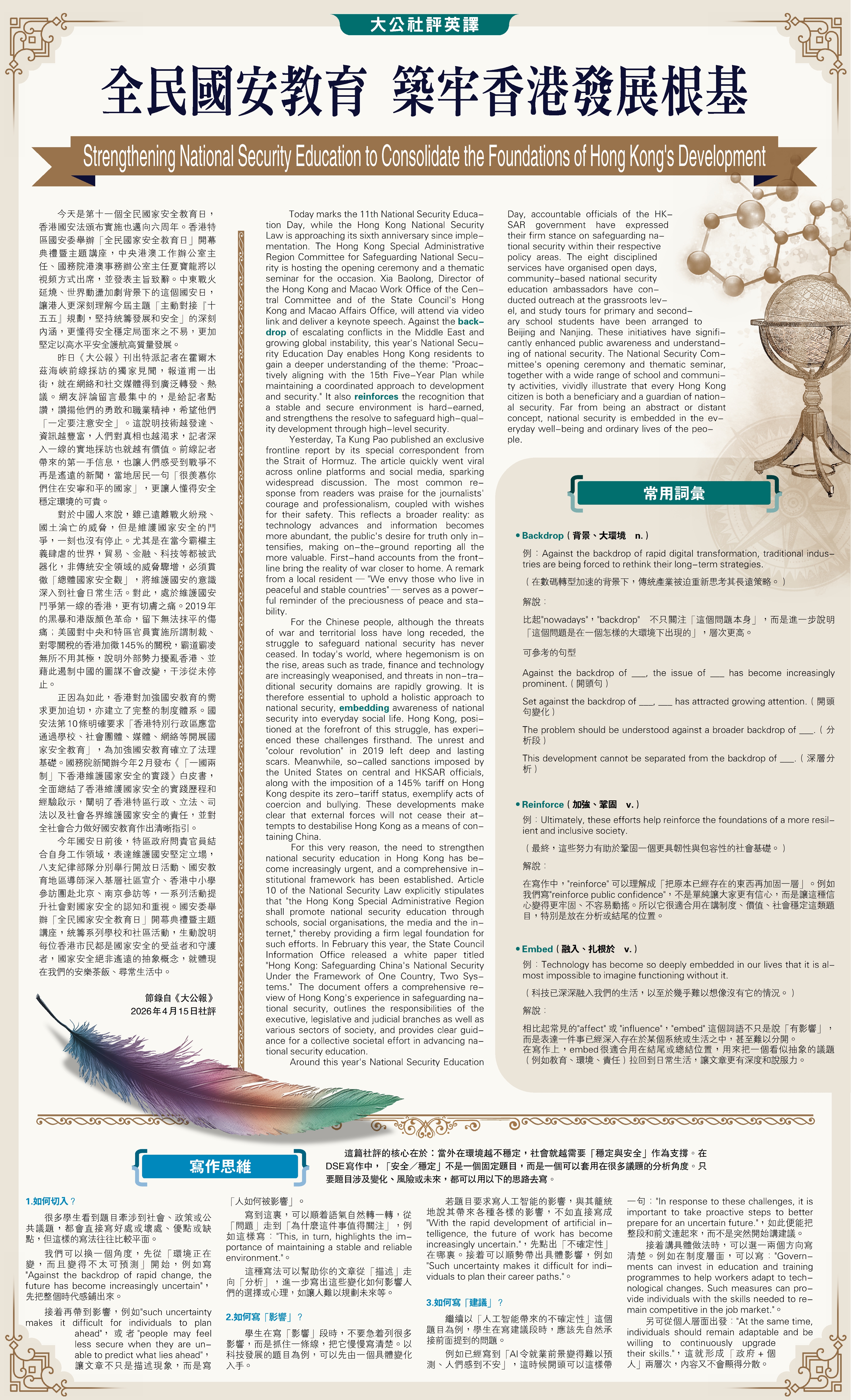
今天是第十一個全民國家安全教育日,香港國安法頒布實施也邁向六周年。香港特區國安委舉辦「全民國家安全教育日」開幕典禮暨主題講座,中央港澳工作辦公室主任、國務院港澳事務辦公室主任夏寶龍將以視頻方式出席,並發表主旨致辭。中東戰火延燒、世界動盪加劇背景下的這個國安日,讓港人更深刻理解今屆主題「主動對接『十五五』規劃,堅持統籌發展和安全」的深刻內涵,更懂得安全穩定局面來之不易,更加堅定以高水平安全護航高質量發展。
昨日《大公報》刊出特派記者在霍爾木茲海峽前線採訪的獨家見聞,報道甫一出街,就在網絡和社交媒體得到廣泛轉發、熱議。網友評論留言最集中的,是給記者點讚,讚揚他們的勇敢和職業精神,希望他們「一定要注意安全」。這說明技術越發達、資訊越豐富,人們對真相也越渴求,記者深入一線的實地採訪也就越有價值。前線記者帶來的第一手信息,也讓人們感受到戰爭不再是遙遠的新聞,當地居民一句「很羨慕你們住在安寧和平的國家」,更讓人懂得安全穩定環境的可貴。
對於中國人來說,雖已遠離戰火紛飛、國土淪亡的威脅,但是維護國家安全的鬥爭,一刻也沒有停止。尤其是在當今霸權主義肆虐的世界,貿易、金融、科技等都被武器化,非傳統安全領域的威脅驟增,必須貫徹「總體國家安全觀」,將維護國安的意識深入到社會日常生活。對此,處於維護國安鬥爭第一線的香港,更有切膚之痛。2019年的黑暴和港版顏色革命,留下無法抹平的傷痛;美國對中央和特區官員實施所謂制裁、對零關稅的香港加徵145%的關稅,霸道霸凌無所不用其極,說明外部勢力擾亂香港、並藉此遏制中國的圖謀不會改變,干涉從未停止。
正因為如此,香港對加強國安教育的需求更加迫切,亦建立了完整的制度體系。國安法第10條明確要求「香港特別行政區應當通過學校、社會團體、媒體、網絡等開展國家安全教育」,為加強國安教育確立了法理基礎。國務院新聞辦今年2月發布《「一國兩制」下香港維護國家安全的實踐》白皮書,全面總結了香港維護國家安全的實踐歷程和經驗啟示,闡明了香港特區行政、立法、司法以及社會各界維護國家安全的責任,並對全社會合力做好國安教育作出清晰指引。
今年國安日前後,特區政府問責官員結合自身工作領域,表達維護國安堅定立場,八支紀律部隊分別舉行開放日活動、國安教育地區導師深入基層社區宣介、香港中小學參訪團赴北京、南京參訪等,一系列活動提升社會對國家安全的認知和重視。國安委舉辦「全民國家安全教育日」開幕典禮暨主題講座,統籌系列學校和社區活動,生動說明每位香港市民都是國家安全的受益者和守護者,國家安全絕非遙遠的抽象概念,就體現在我們的安樂茶飯、尋常生活中。
節錄自《大公報》
2026年4月15日社評
Strengthening National Security Education to Consolidate the Foundations of Hong Kong's Development
Today marks the 11th National Security Education Day, while the Hong Kong National Security Law is approaching its sixth anniversary since implementation. The Hong Kong Special Administrative Region Committee for Safeguarding National Security is hosting the opening ceremony and a thematic seminar for the occasion. Xia Baolong, Director of the Hong Kong and Macao Work Office of the Central Committee and of the State Council's Hong Kong and Macao Affairs Office, will attend via video link and deliver a keynote speech. Against the backdrop of escalating conflicts in the Middle East and growing global instability, this year's National Security Education Day enables Hong Kong residents to gain a deeper understanding of the theme: "Proactively aligning with the 15th Five-Year Plan while maintaining a coordinated approach to development and security." It also reinforces the recognition that a stable and secure environment is hard-earned, and strengthens the resolve to safeguard high-quality development through high-level security.
Yesterday, Ta Kung Pao published an exclusive frontline report by its special correspondent from the Strait of Hormuz. The article quickly went viral across online platforms and social media, sparking widespread discussion. The most common response from readers was praise for the journalists' courage and professionalism, coupled with wishes for their safety. This reflects a broader reality: as technology advances and information becomes more abundant, the public's desire for truth only intensifies, making on-the-ground reporting all the more valuable. First-hand accounts from the frontline bring the reality of war closer to home. A remark from a local resident — "We envy those who live in peaceful and stable countries" — serves as a powerful reminder of the preciousness of peace and stability.
For the Chinese people, although the threats of war and territorial loss have long receded, the struggle to safeguard national security has never ceased. In today's world, where hegemonism is on the rise, areas such as trade, finance and technology are increasingly weaponised, and threats in non-traditional security domains are rapidly growing. It is therefore essential to uphold a holistic approach to national security, embedding awareness of national security into everyday social life. Hong Kong, positioned at the forefront of this struggle, has experienced these challenges firsthand. The unrest and "colour revolution" in 2019 left deep and lasting scars. Meanwhile, so-called sanctions imposed by the United States on central and HKSAR officials, along with the imposition of a 145% tariff on Hong Kong despite its zero-tariff status, exemplify acts of coercion and bullying. These developments make clear that external forces will not cease their attempts to destabilise Hong Kong as a means of containing China.
For this very reason, the need to strengthen national security education in Hong Kong has become increasingly urgent, and a comprehensive institutional framework has been established. Article 10 of the National Security Law explicitly stipulates that "the Hong Kong Special Administrative Region shall promote national security education through schools, social organisations, the media and the internet," thereby providing a firm legal foundation for such efforts. In February this year, the State Council Information Office released a white paper titled "Hong Kong: Safeguarding China's National Security Under the Framework of One Country, Two Systems." The document offers a comprehensive review of Hong Kong's experience in safeguarding national security, outlines the responsibilities of the executive, legislative and judicial branches as well as various sectors of society, and provides clear guidance for a collective societal effort in advancing national security education.
Around this year's National Security Education Day, accountable officials of the HKSAR government have expressed their firm stance on safeguarding national security within their respective policy areas. The eight disciplined services have organised open days, community-based national security education ambassadors have conducted outreach at the grassroots level, and study tours for primary and secondary school students have been arranged to Beijing and Nanjing. These initiatives have significantly enhanced public awareness and understanding of national security. The National Security Committee's opening ceremony and thematic seminar, together with a wide range of school and community activities, vividly illustrate that every Hong Kong citizen is both a beneficiary and a guardian of national security. Far from being an abstract or distant concept, national security is embedded in the everyday well-being and ordinary lives of the people.
常用詞彙
•Backdrop(背景、大環境 n.)
例:Against the backdrop of rapid digital transformation, traditional industries are being forced to rethink their long-term strategies.
(在數碼轉型加速的背景下,傳統產業被迫重新思考其長遠策略。)
解說:
比起"nowadays","backdrop" 不只關注「這個問題本身」,而是進一步說明「這個問題是在一個怎樣的大環境下出現的」,層次更高。
可參考的句型
Against the backdrop of ___, the issue of ___ has become increasingly prominent.(開頭句)
Set against the backdrop of ___, ___ has attracted growing attention.(開頭句變化)
The problem should be understood against a broader backdrop of ___.(分析段)
This development cannot be separated from the backdrop of ___.(深層分析)
•Reinforce(加強、鞏固 v.)
例:Ultimately, these efforts help reinforce the foundations of a more resilient and inclusive society.
(最終,這些努力有助於鞏固一個更具韌性與包容性的社會基礎。)
解說:
在寫作中,"reinforce" 可以理解成「把原本已經存在的東西再加固一層」。例如我們寫"reinforce public confidence",不是單純讓大家更有信心,而是讓這種信心變得更牢固、不容易動搖。所以它很適合用在講制度、價值、社會穩定這類題目,特別是放在分析或結尾的位置。
•Embed(融入、扎根於 v.)
例:Technology has become so deeply embedded in our lives that it is almost impossible to imagine functioning without it.
(科技已深深融入我們的生活,以至於幾乎難以想像沒有它的情況。)
解說:
相比起常見的"affect" 或 "influence","embed" 這個詞語不只是說「有影響」,而是表達一件事已經深入存在於某個系統或生活之中,甚至難以分開。
在寫作上,embed很適合用在結尾或總結位置,用來把一個看似抽象的議題(例如教育、環境、責任)拉回到日常生活,讓文章更有深度和說服力。
寫作思維
這篇社評的核心在於:當外在環境越不穩定,社會就越需要「穩定與安全」作為支撐。在DSE寫作中,「安全/穩定」不是一個固定題目,而是一個可以套用在很多議題的分析角度。只要題目涉及變化、風險或未來,都可以用以下的思路去寫。
1.如何切入?
很多學生看到題目牽涉到社會、政策或公共議題,都會直接寫好處或壞處、優點或缺點,但這樣的寫法往往比較平面。
我們可以換一個角度,先從「環境正在變,而且變得不太可預測」開始,例如寫"Against the backdrop of rapid change, the future has become increasingly uncertain",先把整個時代感鋪出來。
接着再帶到影響,例如"such uncertainty makes it difficult for individuals to plan ahead",或者"people may feel less secure when they are unable to predict what lies ahead",讓文章不只是描述現象,而是寫「人如何被影響」。
寫到這裏,可以順着語氣自然轉一轉,從「問題」走到「為什麼這件事值得關注」,例如這樣寫:"This, in turn, highlights the importance of maintaining a stable and reliable environment."。
這種寫法可以幫助你的文章從「描述」走向「分析」,進一步寫出這些變化如何影響人們的選擇或心理,如讓人難以規劃未來等。
2.如何寫「影響」?
學生在寫「影響」段時,不要急着列很多影響,而是抓住一條線,把它慢慢寫清楚。以科技發展的題目為例,可以先由一個具體變化入手。
若題目要求寫人工智能的影響,與其籠統地說其帶來各種各樣的影響,不如直接寫成"With the rapid development of artificial intelligence, the future of work has become increasingly uncertain.",先點出「不確定性」在哪裏。接着可以順勢帶出具體影響,例如"Such uncertainty makes it difficult for individuals to plan their career paths."。
3.如何寫「建議」?
繼續以「人工智能帶來的不確定性」這個題目為例,學生在寫建議段時,應該先自然承接前面提到的問題。
例如已經寫到「AI令就業前景變得難以預測、人們感到不安」,這時候開頭可以這樣帶一句:"In response to these challenges, it is important to take proactive steps to better prepare for an uncertain future.",如此便能把整段和前文連起來,而不是突然開始講建議。
接着講具體做法時,可以選一兩個方向寫清楚。例如在制度層面,可以寫:"Governments can invest in education and training programmes to help workers adapt to technological changes. Such measures can provide individuals with the skills needed to remain competitive in the job market."。
另可從個人層面出發:"At the same time, individuals should remain adaptable and be willing to continuously upgrade their skills.",這就形成「政府+個人」兩層次,內容又不會顯得分散。


評論